



The TOC-L series of analyzers implements the Shimadzu-developed thermocatalytic oxidation method at 680 °C. Unlike the catalytic systems initially used in similar analyzers with an operating temperature of 900 °C, during the oxidation process at a temperature of 680 °C, no glassy precipitate of salts is formed on the catalyst surface. Under these temperature conditions, salts form a porous precipitate that is easily washed off the catalyst surface. At the same time, this temperature is quite sufficient to ensure the oxidation of any organic molecules. This allows for quick and accurate determination of the total content of organic compounds in water in a wide range of carbon concentrations from 4 μg/l to 30,000 mg/l. Thus, using the TOC-L series analyzers, it is possible to effectively analyze samples of various degrees of contamination, from ultrapure water and washes from cleaning process equipment to wastewater extremely contaminated with organic compounds.
TOC-L
Laboratory total organic carbon analyzers with low-temperature thermocatalytic oxidation reactor

Можливі моделі аналізаторів серії ТОС-L
- model TOC-L CSN (dual control – from the built-in processor or from a PC; lower measurement limit 4 μg/l);
- model TOC-L CPH (control only from a PC; lower measurement limit 4 μg/l);
- model TOC-L CSN (dual control – from the built-in processor or from a PC; lower measurement limit 50 μg/l);
- model TOC-L CPN (control only from a PC; lower measurement limit 50 μg/l).
All TOC-L series instruments can be equipped with the TNM-1 total combined nitrogen determination module. The range of measured nitrogen concentrations is from 5 μg/l to 10 g/l.
Measurable indicators
TOC-L analyzers allow obtaining analysis results for the following parameters: total carbon (TC), total inorganic carbon (IC), total organic carbon (TOC = TC – IC) and total non-volatile carbon (NPOC); optionally total volatile carbon (PIC), optionally TOC through the sum of NPOC and POC, and optionally total nitrogen (TN).

ASI-L automatic sampler

The ASI-L carousel type automatic sampler allows you to expand the functionality of the device. Three types of vials with different volumes are available: 9 ml × 93 (maximum quantity); 24 ml × 93 (maximum quantity); 40 ml × 68 (maximum quantity).
Two types of ASI-L automatic samplers blocks are available: one for working with 24 ml vials, the second for 9 and 40 ml vials. To prevent settling of suspended particles, additional magnetic stirrers can be used to mix the sample – for 24 ml and 40 ml vials. If 24 ml vials are used, then vials 1-85 of 93 are available for mixing.
OCT-L automatic sampler
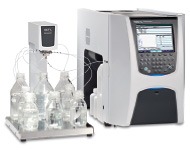 8-port OCT-L autosampler for TOC-L series total organic carbon analyzers.
- Allows the use of any container during analysis, eliminating the need to transfer the sample to special vials required for other types of autodispensers. For continuous analysis, the sample can be added periodically to the bottle.
- Designed for analysis of up to 8 samples. Adding a second OCT-L autosampler allows you to increase the number of analyzed samples to 16.
- Any commercially available magnetic stirrer (purchased separately) can be used to mix the sample in the bottles.
TNM-L prefix for total nitrogen determination

The method for determining total nitrogen is based on catalytic thermal decomposition (720 °C) followed by chemiluminescent detection. The range of detectable concentrations is from 5 μg/L (for TOC-LCSH and TOC-LCPH models) to 10,000 mg/L. (TN determination is not possible in combination with SSM-5000A)
SSM-5000A attachment for solid sample analysis
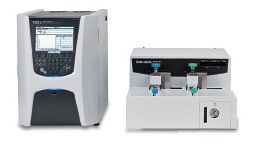
The combination of the SSM-5000A with the TOC-L series carbon analyzers allows, in addition to liquid samples, the analysis of water samples containing a large amount of suspended particles (not suitable for the analysis of seabed samples due to the high salt content), as well as solid samples such as soil, silt and sediment samples. The attachment allows the analysis of samples obtained by the «scraping» method from any surface to confirm the cleanliness of this surface. Direct combustion of the swab or napkin used in the analysis process is used. The minimum measurable amount of carbon is 1 μg. (Determination of total nitrogen (TN) is not possible in combination with the SSM-5000A).
Additional equipment for TOC-L
Kit for analysis of high-salt samples. This kit allows you to extend the service life of the catalyst and catalytic oxidation tube when analyzing samples with a high salt content, such as seawater. Allows you to perform approximately 2500 measurements with a sample volume of 40 μL. (Approximate values, guaranteed).
B-type halogen scrubber. This kit effectively removes corrosive gases generated when measuring samples containing salts, thereby reducing NDIR cell degradation.
Small volume sample analysis kit. This kit allows you to work with smaller sample volumes.
Carrier gas purification kit. Compressed air from a cylinder or compressor can be used as a carrier gas after removing carbon-containing impurities (СО2 or hydrocarbons). The kit is used for models TOC-LCSN/CPN.
Gas sample dispensing kit. This kit allows manual dosing of a liquid or gaseous sample with a microliter syringe. Total carbon (TC), СО2 and total organic carbon (TOC) can be determined in a gas sample. TOC is defined as the difference between TC ТС – СО2. CO is included in TOC.
Kit for determination of volatile organic carbon (VOC). This kit allows the determination of volatile organic carbon released from a sample during bubbling at room temperature.
Kit for using nitrogen as a carrier gas. This kit allows the use of nitrogen as a carrier gas instead of ultra-pure air. The purity of the nitrogen must be 99.999% or higher. When using this kit, the ranges of detectable concentrations of both total organic (TOC) and inorganic (IC) carbon are limited to values from 0 to 100 mg/L. Does not work with the TNM-L prefix.
Suspension analysis kit. The standard sample introduction capillary has a diameter of 0.5 mm. This kit increases the diameter to 0.8 mm, allowing the analysis of suspensions. For reliable analysis of suspensions, their maximum homogenization is important.