


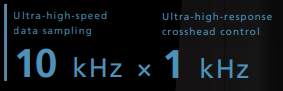
- Multiple channels for high-speed data sampling and subsequent processing. The patented Shimadzu controller is equipped with two processors and three data processing modules. It allows you to control the position of the traverse with a response of 1 kHz and to sample data at a frequency of 10 kHz. Simultaneous multi-threaded processing of results is based on a system of function distribution and synchronization of different devices.
I. Full control of the testing process
- Give control of the deformation rate to the machine’s automatic functions. Controlling parameters during an experiment is often a big problem that cannot always be solved with standard auto-correction. High accuracy and stability of measurements in AGX-V series machines is ensured not only by traditional sensor polling and response to parameter changes, but also by building mathematical models based on the data received in real time.
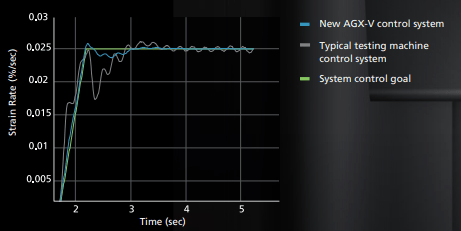
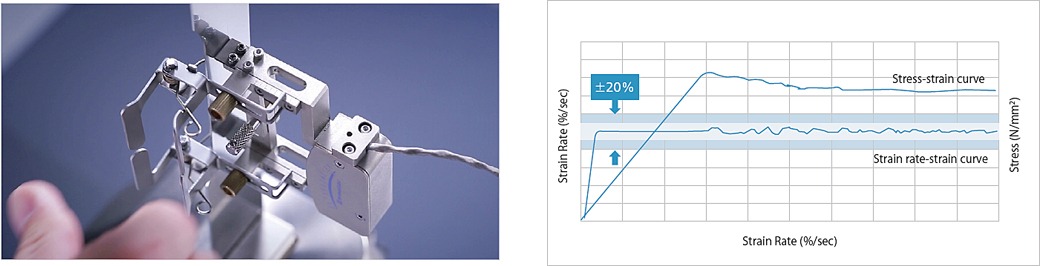
- Testing of steels and non-ferrous metals. When measuring material properties at the initial stage of deformation using an extensometer, it is necessary to maintain a certain strain rate. This requires high-precision equipment that responds to the slightest changes in the material. The ISO 6892 (JISZ 2241) standard, which describes tensile testing of metals, establishes a permissible error in maintaining the strain rate. It is ± 20% of the specified value and must be maintained until the yield point is reached. On the AGX-V series machines, this requirement is met for most materials. *1
- Simulating specific conditions during testing. When testing, for example, engine mounts or any other rubber products under constant stress, it is necessary to continuously monitor and adjust the position of the traverse according to the elastic state of the sample. The high response frequency of the traverse *1 helps to constantly monitor its movement and eliminates force fluctuations.
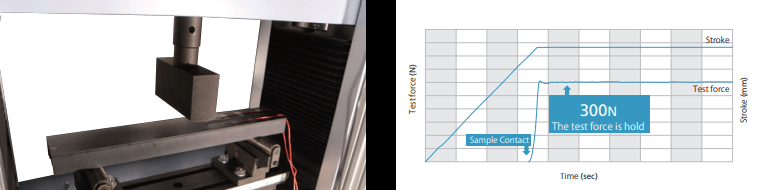
- Compression and bending tests with load retention. During compression and bending tests, when the plate or punch is freely lowered until it contacts the specimen and then a constant load is applied, highly accurate and stable test control is also guaranteed. The variation of the values when applying force in this mode is no more than 1% of the specified load, even for high-strength materials.*1
*1 The accuracy of the characteristic maintenance during the test depends largely on the material properties and test conditions. The graph is provided as an example only and does not guarantee similar accuracy for all materials and test types.
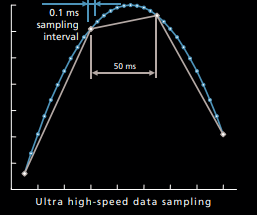
- Fixing even minor changes. The load cell polling and data acquisition frequency is now 10 kHz (0.1 ms). This allows even the smallest load fluctuations, such as those that occur during brittle fracture of a material, to be captured.

- Operation in different load ranges without replacing cells. The range of guaranteed accuracy has been increased. It now starts from 1/2000 of the maximum nominal value of the load cell. This allows you to trust the results even at minimum loads. Only one measuring cell is required, which not only simplifies the work, but also reduces the costs of equipment verification procedures.
- Simultaneous data collection and analysis on multiple channels using a built-in controller without additional devices. The controller is equipped with up to 20 amplifiers for signal processing of external devices. At the same time, the sensor can operate in the “Analog” and “Counter” modes, which simplifies information collection and does not require the connection of any additional signal processing modules. Data from the load cell, extensometer and external analog device are recorded simultaneously during the entire test, allowing you to obtain the necessary information about the sample. This is especially important, for example, when estimating the modulus of elasticity, when at least two sensors are used simultaneously in the calculations..
II. Precise positioning of the grips and the sample
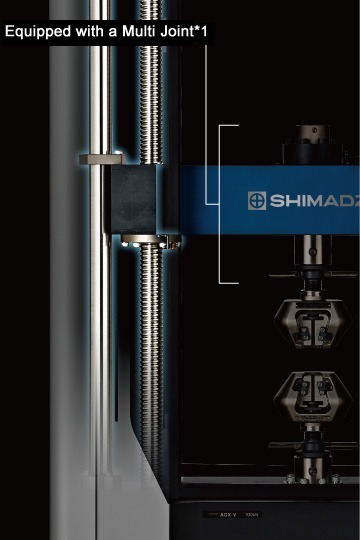
- New universal connector.*1 A rigid, reliable fixed-type device is now used as a universal connecting element. For safe operation and high repeatability of results, the accuracy of maintaining the alignment of the equipment elements has been increased.
- Safety and ease of use. No more need to change bulky connectors, even when installing additional load cells of a smaller rating. This reduces labor costs, time for changing equipment and reduces the risk of injury when handling heavy elements.
- Factory-adjusted grip alignment meets ASTM E1012 Class 10.*2 The AGX-V series of testing machines can be supplied with a factory-set grip alignment that meets ASTM E1012 Class 10. This machine setting ensures reliable and repeatable results, which is especially important for testing high-strength materials and composites.
- High rigidity and precise alignment of the equipment due to the new frame design. The vertical guides *2 are now equipped with a special insert ring *2 that maintains a constant angle between the columns and the table surface. This ensures stable results, even when testing fragile or high-strength samples.
*1 Available for tabletop and floor models with ratings from 20 kN to 300 kN.
*2 Available only for floor models with a rating of 20 kN to 300 kN. Alignment calibration is performed at the factory and is not guaranteed if the attachment elements are tampered with. Alignment is guaranteed up to the machine frame rating. (For the AGX-300 kNV model up to 100 kN).