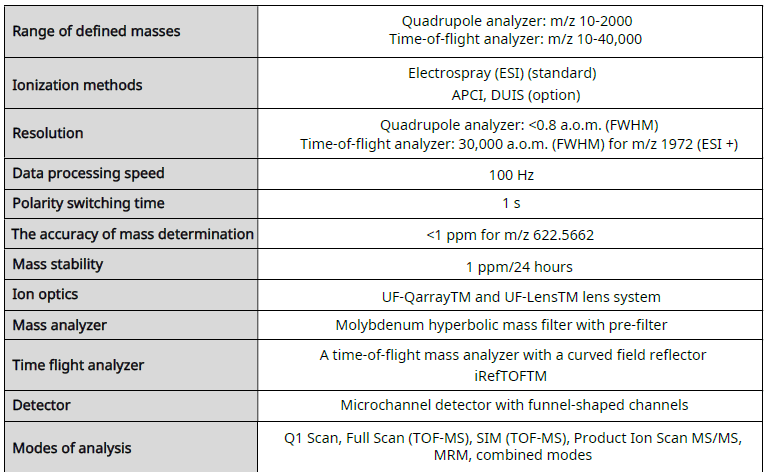



The new LCMS-9030 Q-TOF mass spectrometer combines Shimadzu’s ultrafast quadrupole (Q) technology with a high-resolution time-of-flight (TOF) mass analyzer. Shimadzu’s extensive experience in the development and manufacturing of mass spectrometry instruments has enabled it to create the LCMS-9030 liquid quadrupole/time-of-flight mass spectrometer, which successfully solves the most complex qualitative and quantitative analysis tasks.
LCMS-9030
Liquid quadrupole/time-of-flight (Q-TOF) chromatograph-mass spectrometer

Features
To perform analytical work requiring very high sensitivity, triple quadrupole mass spectrometers of the LCMS-8050 and LCMS-8060 models are used. However, the presence of even highly sensitive triple quadrupole devices does not allow solving another important task – reliable detection of all organic compounds obtained during the synthesis process, including the establishment of their structure. To solve this task, the LCMS-9030 mass spectrometer, which combines quadrupole and time-of-flight mass analyzers, is effective. The LCMS-9030 design uses new patented technologies that provide a high level of mass resolution and accurate determination of molecular mass. This is a determining factor in the identification of unknown compounds and the establishment of the structure of molecules. In addition to the default electrospray ionization (ESI) source, the LCMS-9030 can be equipped with an atmospheric pressure chemical ionization (APCI) source and a combined ionization source (DUIS), which allows simultaneous ionization of the sample in electrospray mode and in atmospheric pressure chemical ionization mode.
A very important practical advantage of the LCMS-9030 is the convenient calibration standard introduction system (CDS). It involves the use of a separate ionization capillary, which operates independently of the main ionization capillary. Thanks to this, the calibration standard can be introduced into the mass spectrometer at any time without changing the solution supply line, which eliminates the risk of contamination of the main analytical line.