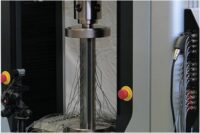
I. Precise results when working with high-strength materials

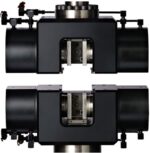
Hydraulic Flat Grips (100 кН, 300 кН, 600 кН)

The hydraulic flat grippers are characterized by a stable force and secure sample hold. The grippers can be opened and closed using the remote touch control. The gripping force is also adjustable. The grippers have guides for easy sample placement and are driven by a special hydraulic station that can operate in low power mode.

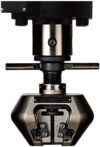
Manual non-shift Wedge Grips

The sample is fixed in the grippers with wedge-shaped inserts, the distance between which is adjusted by rotating the handle. The inserts can be easily changed and, depending on their shape, allow you to work with both flat and rod-shaped samples. This design is extremely reliable, and the grippers themselves are relatively inexpensive.

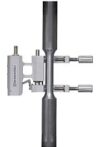
Differential Transformer Extensometer

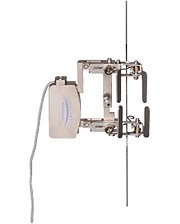
This type of sensor is used to evaluate the deformation of metals, hard polymers, and other materials with low relative elongation. They are easy to use, especially when connected to AGX-V series machines.

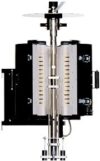
High-temperature test device

The furnace is designed to test heat-resistant alloys and ceramics. Measurements in them are carried out with constant monitoring of stress and strain due to the presence of special high-temperature elongation sensors. The furnaces have several different modifications and allow testing at temperatures up to 1500°C.

Low-temperature test device

To perform tests at cryogenic temperatures, a device with a special liquid nitrogen tank is used. Tests are carried out at a temperature of -196°C.

II. High efficiency during light load tests

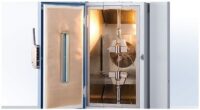
Temperature and humidity control is of particular importance, especially when the material is sensitive to these parameters. Shimadzu offers thermal chambers with different types of cooling: LPG or refrigerated. When you install thermal chambers on AGX-V machines, you get a number of additional benefits. The high traverse return speed of the AGX-V accelerates temperature testing and reduces gas consumption. An automatic extensometer and a new gripper control function with a remote touchscreen control panel further increase efficiency and reduce downtime of the test machine.

Grippers and devices for temperature testing

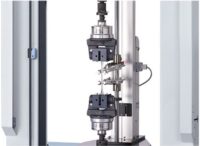
The testing machine is equipped with grippers and other necessary devices for tensile, compression and bending tests at high and low temperatures.

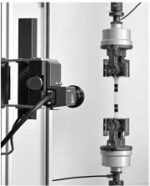
Automatic extensometer SIE-560A/560SA

The extensometer has a variety of built-in functions: it independently determines the position of the grippers and is fixed on the measuring base of the sample between them, automatically releases the sample after the end of the test and returns to the initial position. Thus, after installing the sample, the operator does not need any actions other than starting the test. The machine will work in automatic mode. The line of these devices includes a high-precision extensometer with an absolute measurement error of ± 1 μm.

Pneumatic Flat Grips

These grippers are equipped with a control pedal or a special pneumatic switch, which allows you to start the test automatically immediately after fixing the sample. Pneumatic grippers have a constant force of compression of the sample, which is especially important when testing soft materials that tend to decrease in thickness during stretching (rubber, elastic polymers, etc.).

SG series strain gauge

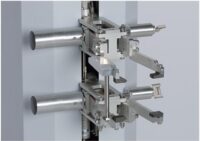
A widespread type of mounted extensometers. It has many modifications that differ in bases and movement during stretching, and allows testing according to specified ISO, ASTM, JIS and GOST standards. There are versions of sensors for operation at elevated temperatures.

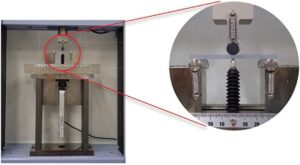
TRViewX video extensometer

Designed for non-contact high-precision measurement of sample deformation using video signal processing. Can be used when testing most known types of materials. Unlike the contact type extensometer, which can damage soft and thin samples, it is suitable for measuring the elongation of films and foils.

Three-point bend test device with a bend sensor

Designed for bending tests according to ISO 178, JIS K7171 and GOST 11262-2017. The sensor is located directly under the sample in its central part. The accuracy of deflection measurement with this sensor fully meets the above standards.
The device is equipped with a mechanism for compensating the pressure of the sample that occurs when it is placed over the sensor. Thanks to this, it is possible to obtain reliable data on the modulus of elasticity of the sample during bending.

* Some devices may require special equipment to use. Please contact your Shimadzu representative.

III. Accurate simulation of test specimen operating conditions

When conducting any mechanical tests (both standardized and non-standard), it is necessary to simulate the operating conditions of the tested product or the operating conditions of the material as accurately as possible. For this, AGX-V series machines are equipped with high-precision load sensors and a new controller that allows processing up to 20 data channels. The test system has a high degree of automation, which greatly simplifies work. AGX-V machines can also be equipped with a regular WEB camera with a USB connection for video recording of the test process. The selection of specialized equipment completes the process of modeling the operating conditions of products and allows you to conduct reliable and accurate tests.

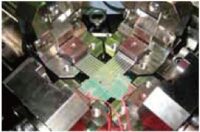
Biaxial stretching

For testing according to ISO 16842, Shimadzu can offer a special system that creates a biaxial load with the ability to adjust the force.

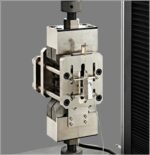
Tests with a change in the direction of loading (Baushinger effect research)

A flat sample is subjected to a preliminary load in the direction of stretching to small values ​​of plastic deformation, followed by unloading and compression. After that, the sample is subjected to stretching again. The special equipment for this test is designed to prevent bending of the specimen when the direction of loading is changed.

Testing of finished products

Large-sized parts are tested for compression using compression plates of various shapes and sizes. Such tests allow not only to evaluate the strength of the material or the product as a whole, but also to simulate its working conditions.

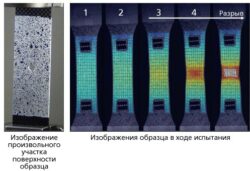
DIC analysis (Image-based deformation estimation)

The method of digital image correlation (digital image correlation, DIC) allows you to monitor the change of the surface of the sample and is used in the optical assessment of deformation. Deformation is calculated by comparing the initial image and the image of the deformed sample. The stress distribution in the sample can be represented in the form of a 2-D model without resorting to the installation of any additional optical systems. Images and video files are acquired using a TRViewX video extensometer. (DIC analysis software is ordered separately).

* Some devices may require special equipment to use. Please contact your Shimadzu representative

IV. TRAPEZIUMX-V software for universal testing machines AGX-V series

  • Convenience of work and wide functionality. Thanks to the new TRAPEZIUMX-V software, operators without experience working on test equipment will be able to use all the capabilities of the new universal machines of the AGX-V series. The program is equipped with a self-learning function – the interface is adapted to each user.
  • Five software modules.

Module «Single». Designed for simple unidirectional tests. Allows to work in the modes of stretching, compression, bending and delaminationя.

Module «Cycle». Designed for simple cyclic tests (low frequency, small number of cycles).

Module «Control». Designed for creating complex test models. For example, step cycles during foam rubber compression tests.

Module «Texture». Intended for evaluating the texture of food products and pharmaceuticals. Including, it allows to obtain data on the gel-forming ability (Bloom’s method) and adhesive properties of materials and products.

Module «Spring». A specialized software package for spring testing.

  • Simple selection of test parameters thanks to a user-friendly interface. The test parameters are set by sequentially moving through the settings tabs when creating a new method. When choosing parameters, the tabs show drawings and graphs for clarity. This makes it easier to work with the software.
  • Data integrity functions. Demarcation of access, maintenance of a control log and automatic data transfer ensure the preservation and reliability of test results. Recording of the test process using a USB camera (Video recording starts at start-up and ends after the end of the test; viewing the test video is synchronized with the chart; video frames can be inserted into the report).
  • Simplified test setup. The simplified parameter setting mode ensures quick setup and test start. In this mode, only the main test parameters are displayed on the screen. Thanks to this, you will be able to conduct the test as quickly as possible. Then, in the re-analysis mode, you can process the results and calculate all the necessary characteristics of the material. Automatic calculation of the modulus of elasticity without specifying the calculation parameters. Such a basic characteristic in materials science as the modulus of elasticity is now calculated automatically, without the need to specify the calculation parameters. Thanks to this, it becomes easier to conduct tests even of those materials whose properties are not reliably known.
  • Convenient functions to save effort and time.

The function of re-analyzing data in offline mode allows you to increase work efficiency. Even during the test, you can now open a second window (by restarting the program) and work in it offline. In the second window, the possibility of creating a new method and the function of re-analysis of previous results will be available.

The test conditions are monitored using sensors with a high response frequency. Data on changes in elongation, tension and other characteristics can be calculated and displayed on the screen in real time. In this way, the operator can control the parameters he is interested in directly during the test and make sure that the work is carried out in strict accordance with the regulations..

Remote viewing of results using a web application. With the help of a special application, you will be able to read the test results remotely. The application is launched in a browser and is therefore supported by most modern devices (personal computers, tablets, smartphones, etc.).