



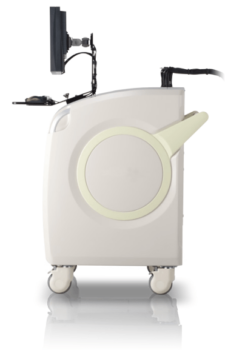
LABNIRS is an advanced functional near-infrared spectroscopy system developed by Shimadzu for scientific research. The system represents a new stage in the development of optical imaging of brain function, offering enhanced capabilities for a deeper understanding of the human brain. Using the latest scientific advances and technologies, LABNIRS makes a significant contribution to the development of neuroscience, providing researchers with a powerful tool for studying cerebral function.
LABNIRS
functional Near-Infrared Spectroscopy System (fNIRS)

How it works
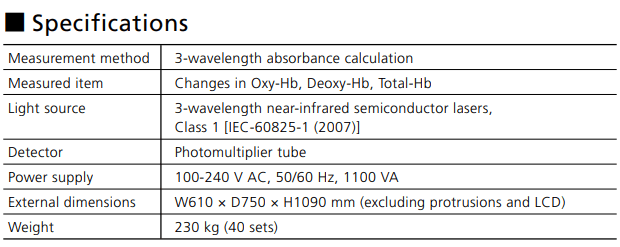
The LABNIRS functional near-infrared spectroscopy system measures brain activity using infrared light that penetrates biological tissues. It uses three laser wavelengths to accurately detect changes in the concentration of oxygenated and deoxygenated hemoglobin.
The light passes through the skin and bones to the cerebral cortex, where it is partially absorbed, scattered, and recorded by photomultipliers. This gives the system high sensitivity and a sampling rate of 6 ms, allowing it to capture neural responses in near real time.
LABNIRS supports up to 40 fiber bundles, creating 142 measurement channels. The spatial resolution is twice as high for more accurate analysis of brain activity. Flexible fiber placement allows for effective coverage of areas of interest.
The system also supports simultaneous NIRS and EEG measurements, allowing for the correlation of electrical processes with hemodynamic changes.
Research applications
LABNIRS provides measurements of brain activity under movement conditions, making it an effective tool for rehabilitation, neurological, psychiatric, and cognitive research.
- Rehabilitation and neuroscience
Allows analysis of brain activity during exercise, which is useful for stroke recovery and neurological disorders. Used in speech and occupational therapy to improve speech and motor functions. - Neurology and Psychiatry
Used to study mental disorders (depression, schizophrenia), predict drug efficacy, and monitor therapeutic outcomes. - Neonatal Brain Function
Safe method for assessing the development of sensory functions in infants, including analysis of touch, hearing, and vision. - Robotics and Engineering
Supports real-time NIRS and EEG measurements, allowing for analysis of movements and their relationship to brain activity. Used in the development of brain-machine interfaces (BMIs) to control devices via brain signals. - Cognitive Psychology and Education
The ability to conduct measurements on multiple objects simultaneously, allowing for the study of cognitive processes in the laboratory. Analysis of the relationship between eye movements and brain activity helps study attention and decision-making. - Emotional Research (Kansei)
Assessing the impact of products and design on brain activity, helping to understand the emotional and psychological response of users.ачів.

Scalability, adaptability, and easy management
The LABNIRS system is designed for maximum simplicity and speed of setup, making it accessible even to researchers without deep technical training.
- Intuitive graphical interface – allows you to quickly change key measurement parameters without complex configurations.
- Automated analysis functions – support for statistical data processing using the general linear model (GLM), batch processing of results and noise filtering to increase the accuracy of research.
- Flexibility in settings – the ability to adapt to different types of experiments, from laboratory cognitive tests to research in natural conditions.
LABNIRS allows you to expand the capabilities of the system according to the needs of the researcher.
- Flexible expansion of the number of measurement channels – you can start with a basic configuration and gradually increase the system’s power.
- Different options for the arrangement of optical fibers – allow you to adapt the system to study specific areas of the brain.
- Stability of measurements in motion – specially designed holders allow the sensors to be fixed on the subject’s head even while walking, running, or performing complex motor tasks.
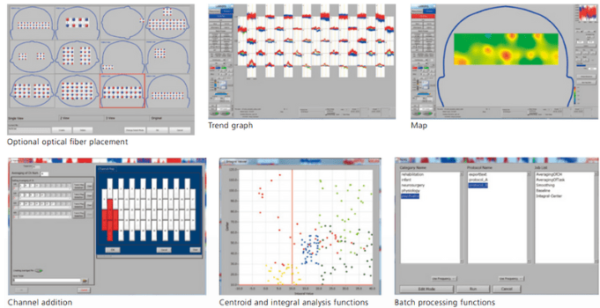
Advanced features and additional options
LABNIRS supports a wide range of additional features:
- Video recording system – synchronized capture of movements for analysis of brain activity.
- Simultaneous EEG measurement – integration with EEG for combined analysis of electrical activity and cerebral blood flow.
- Stimulus presentation system – presentation of visual and auditory stimuli for real-time study of neural responses.
- MRI data fusion – software for combining fNIRS and MRI data for more accurate 3D analysis.
- Real-time data transmission – continuous monitoring and adaptation of the experiment.
- 3D position measurement system – precise registration of optical fiber positions for increased accuracy of results.
- Optical fiber expansion – the ability to add fibers for greater brain coverage and setup flexibility.

Holders and fibers
Holders and fibers play a key role in making accurate optical measurements and ensuring stable contact with the surface of the object under study. In this subtopic, we will consider their features and variations.
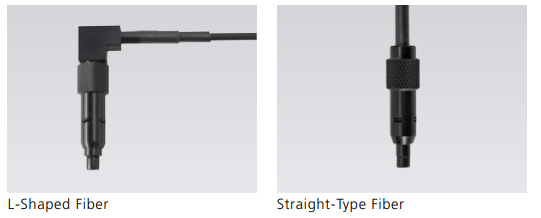
- Types of fibers
Fibers are used to transmit light to an optical measurement system. They come in different shapes, which affects the quality and accuracy of the data obtained:
- L-shaped fiber – convenient for working in confined spaces and angular measurements.
- Straight-type fiber – provides direct light transmission without deviations.
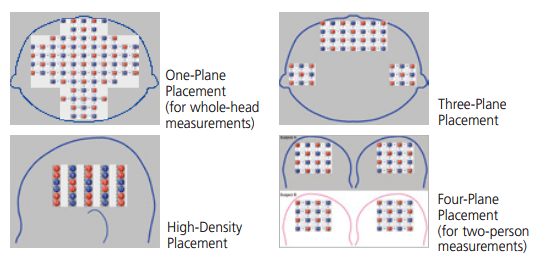
- Flexible fiber placement
Flexible fiber placement allows you to adapt the system to the needs of a specific study:
- One-plane placement – used for measurements with a limited coverage area.
- Three-plane placement – provides an extended coverage area.
- Combined placements – allow you to measure multiple areas simultaneously.
- Fiber Holders
Holders help to fix the fibers stably on the surface to reduce artifacts during measurement:
- Frontal fiber holders – used for studies in the forehead area.
- Parallel fiber holders – ensure uniform arrangement of fibers on the surface.
- Guided fiber holders – help to direct the light in a given direction.
- Covering holders – can cover the entire head for large-scale measurements.
- Simultaneous EEG holders – used for parallel analysis of electrical activity of the brain.
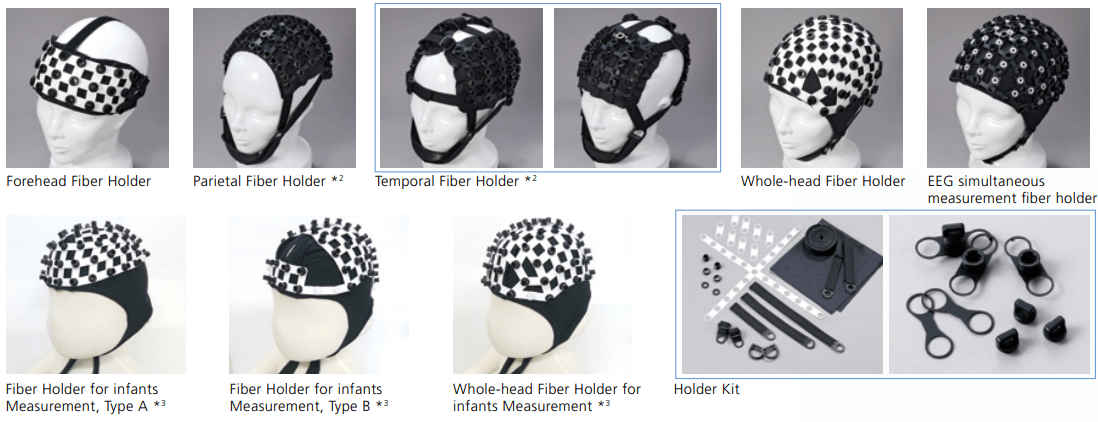
*1 Patented in Japan 04254420
*2 Supports high-density measurement at short distance
*3 Exclusive use of fiber set for infant measurement