



Shimadzu’s ICPMS-2040 and ICPMS-2050 inductively coupled plasma mass spectrometers represent a revolutionary step in the development of elemental analysis technology. These innovative instruments combine unsurpassed sensitivity, environmental friendliness and ease of use, setting new standards in the field of analytical chemistry. The ICPMS-2040 and ICPMS-2050 are designed to meet the most demanding needs of modern laboratories, providing accurate and reliable multi-element analysis over a wide concentration range – from ultra-trace amounts to major components. These instruments are ideal for a variety of applications in the fields of environmental monitoring, pharmaceutical research, food quality control, geochemistry and many others.
ICPMS-2040 and ICPMS-2050
Mass spectrometers with inductively coupled plasma
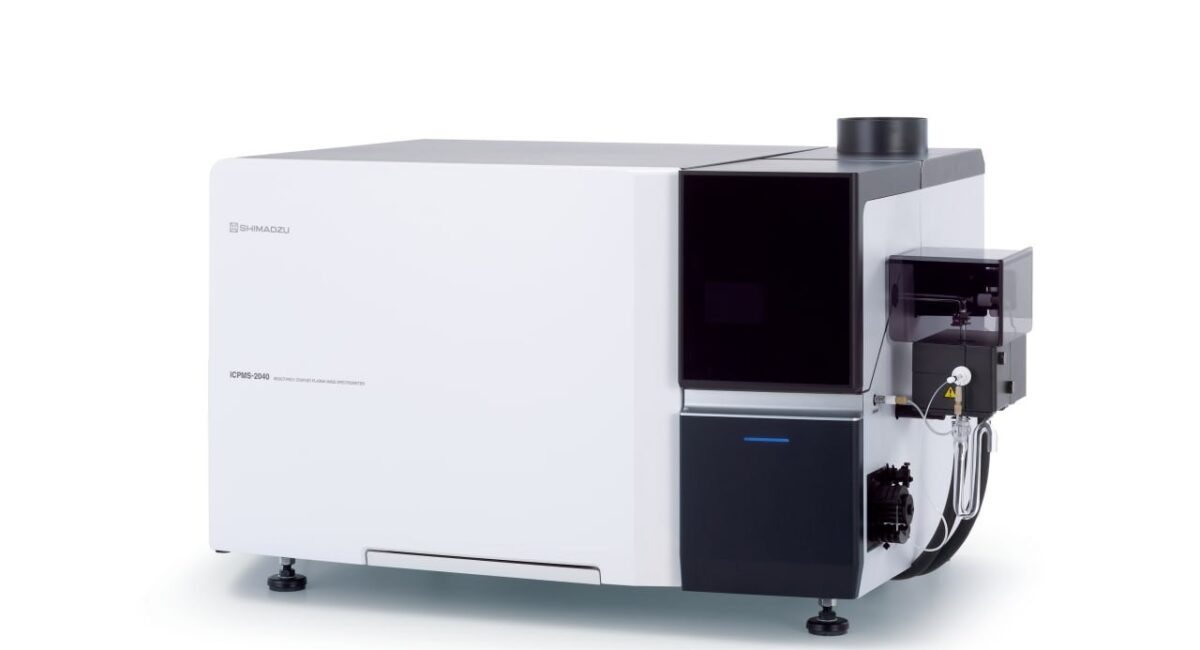
Features of devices
- Mini-torch. The new mini-torch in the ICPMS-2040 provides twice the sensitivity compared to previous versions of the instrument with significantly reduced argon consumption. The optimized design of the burner increases the efficiency of sample ionization, which minimizes the risk of nozzle clogging and ensures stable operation of the instrument. The ICPMS-2050 model retains all these advantages, but is additionally optimized for working with reactive gases, which expands its functionality and allows you to achieve even better results in a variety of analytical tasks.
- Economical gas consumption. The ICPMS-2040 uses only 11 l/min of argon, which is two-thirds less than conventional ICPMS systems. With Eco mode, argon consumption can be further reduced to 5.5 l/min in standby mode. The ICPMS-2050 maintains this economy, adding optimizations for efficient use of reaction gases, making it even more functional and productive.
- Possibility of using low purity argon. One of the key advantages of both models. Thanks to the innovative high-frequency power supply equipped with a high-speed matching function, these devices are able to work effectively with relatively inexpensive low-purity argon (99.95%). This solution allows to significantly reduce operating costs, as it is no longer necessary to use expensive high-purity gas.
- Advanced collision cell/reaction cell. The ICPMS-2040 is equipped with a collision cell that effectively eliminates spectral interferences using an inert gas (helium). This significantly improves the accuracy of the analysis and reduces the influence of unwanted signals. The ICPMS-2050 offers an additional ion reaction mode. This feature allows the use of specific reaction gases, such as a mixture of 10% ammonia and 90% helium, to further eliminate interferences when analyzing complex matrices. This approach achieves a high level of selectivity and accuracy even in the most difficult analytical tasks, making this model the ideal choice for applications with high data quality requirements.
- Interelement correction (IEC). This feature is available in both models, providing precise correction of spectral interferences that cannot be eliminated in collision mode. Thanks to IEC, the systems can automatically correct for the influence of interferences, which significantly increases the accuracy and reliability of the analysis, even in cases where interferences are difficult to eliminate with traditional methods. This makes both models even more efficient and versatile for a variety of analytical tasks.
- High-efficiency quadrupole mass filter. This filter is used in both instruments. It provides a stable signal over a long analysis time thanks to a unique charge stabilization technology. This technology guarantees the accuracy and reliability of the results, reducing the influence of possible changes in the mass filter and ensuring constant measurement quality even during long analytical studies on the instrument.
- High throughput. “High-speed gas purge” and “ProActive Rinsing”, these systems significantly reduce analysis time. “High-speed gas purge” ensures rapid removal of contaminants and residual elements, while “ProActive Rinsing” actively maintains the cleanliness of the system between measurements, avoiding interruptions and increasing analysis efficiency.
- Automated functions. The “Extended Rinse” feature automatically minimizes carryover between samples, ensuring high accuracy and repeatability of results. The “Dual Valve Block” allows the system to operate autonomously after plasma ignition, reducing the need for constant monitoring and operator intervention.
- Advanced analytical capabilities. The ICPMS-2040 provides high sensitivity and accuracy for a wide range of elements, making it a versatile tool for a variety of analytical tasks. The ICPMS-2050 offers increased sensitivity for complex elements thanks to its integrated reaction mode. This makes the model particularly effective for the analysis of semiconductors, pharmaceuticals and biological samples, where accuracy and sensitivity are critical.
- Flexibility of methods. The ICPMS-2040 allows for optimized analysis using collision mode, which helps reduce spectral interference and improve accuracy of results for a wide range of elements. The ICPMS-2050 provides even greater flexibility by offering the ability to switch between collision mode and reaction mode. This allows for tailoring analysis methods depending on the specifics of the elements being studied and the composition of the samples, making the system even more versatile and effective for a variety of analytical tasks.
- Software. Both models are equipped with advanced LabSolutions ICPMS software with “Assistant” and “Diagnostic Assistant” functions to automatically optimize analysis conditions and verify data validity.
- Regulatory compliance. Both models are FDA 21 CFR Part 11 compliant, making them ideal for use in regulated industries.
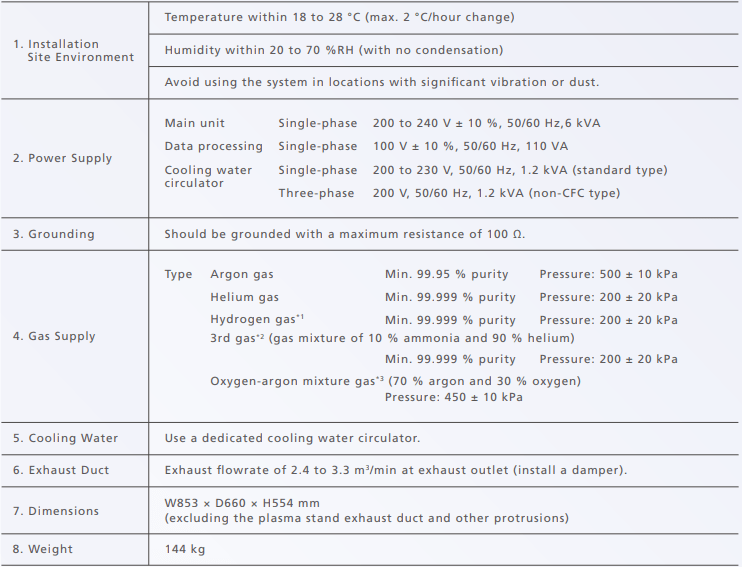
Additional equipment
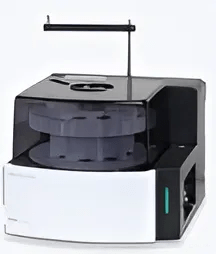
AS-20 autosampler (for automatic analysis of 60 samples). Designed for sequential analysis of a series of samples. The turntable provides a short sample entry path and allows you to reduce the washing time. Vials: 60 pcs. 15 ml or 8 pcs. 50 ml. Dimensions: W290 × D508 × H300 mm (without sleeve). Power supply: Single-phase 100-240 V, 50/60 Hz, 50 VA. Weight: 11 kg (main unit) Additional option: washing port kit.
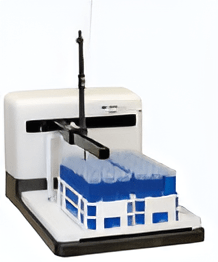
ASX-280 autosampler (for simultaneous analysis of 120 samples). Vials: 10 x 50 ml (for standard samples) or 120 x 14 ml; 80 x 20 ml (stand sold separately); 42 x 50 ml (stand sold separately). Dimensions: W360 x D550 x H660 mm (including sample probe). Power supply: 100–240 VAC, 50/60 Hz, 200 VA. Weight: 8.1 kg (main unit).
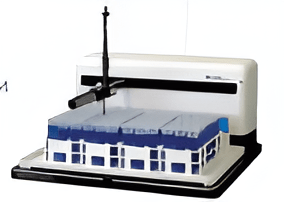
ASX-560 autosampler (for simultaneous analysis of 120 samples). Vials: 10 x 50 ml (for standard samples) or 240 x 14 ml; 160 x 20 ml (stand sold separately); 64 x 50 ml (stand sold separately). Dimensions: W580 x D550 x H620 mm (including sample probe). Power supply: 100–240 VAC, 50/60 Hz, 200 VA. Weight: 12 kg (main unit).
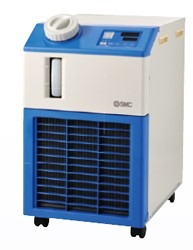
Cooling water circulator (Standard model). Dimensions: W377 x D500 x H615 mm. Power supply: Single-phase 200 to 230 V, 50/60 Hz, 1.2 kVA. Weight: 43 kg.
Note:
- used to cool the main unit
- a separate kit is required to connect the chiller
Cooling water circulation pump (No Freon model). Dimensions: W400 × D600 × H697 mm. Power supply: Three-phase 200 V 50/60 Hz, 1.2 kVA. Weight: 58 kg.
Note:
- used to cool the main unit
- requires a separate refrigeration unit connection kit, Apiste
Double valve block. This is used to automatically switch between multiple solutions such as pure water, instrument calibration solution, internal standard solution, and cleaning solution.
HFS-6 Hydrofluoric Acid Sample Injection System. This system is used for direct injection of samples containing hydrofluoric acid. Fluoropolymer materials are used in the nebulizer, chamber, and drainage system, while alumina is used in the injector on the torch.
Ionic system of organic solvent. For organic solvent analysis, a gas mixture of 70% argon and 30% oxygen is injected into the burner to prevent carbon (C) from escaping from the organic solvents. This system includes a mixed gas controller, a quadruple organic solvent burner, and an organic solvent pump tube (for ethanol/methanol/IPA).
HFS-6 Hydrofluoric Acid Sample Injection System. This chamber is used to analyze traces of boron, which is difficult to analyze using a standard borosilicate glass chamber.
Standard torch kit. This kit includes a flashlight with a 1.8mm injector hole diameter that supports 1.6kW high-frequency output, as well as a compatible protective shield, hood, and adapter.
3rd gas injection unit. This gas control unit is designed to use a gas mixture of 10% ammonia and 90% helium as a reaction gas in the ICPMS-2050 system.
Water bubbler. This is used to humidify the argon gas and prevent clogging of the burner and nebulizer when analyzing high TDS samples.
LC Connect ion Kit. This connection kit is required to set up an LC-ICP-MS system that combines an ICPMS-2040/2050 series system with a Nexera or Prominence inert analysis system. For information on compatible LC systems, contact Shimadzu.
LabSolut ICPMS TRM ions. This software is designed to control Shimadzu LC and ICPMS-2040/2050 series systems and analyze chromatography data.
Rotary pump, PFPE. This pump is lubricated with PFPE oil, allowing the pump to be used for a variety of applications, from routine analysis to LC-ICP-MS analysis. Dimensions: W496 × D295 × H325 mm. Weight: 50 kg.
Dry pump. This oil-free dry pump has low maintenance requirements. Dimensions: W494 × D217 × H301 mm. Weight: 30 kg.