



This is a unique instrument from Shimadzu for special studies in the subnanometer range (measurement starts from 0.5 nm). Based on the induced grating (IG) method, this analyzer provides high accuracy and speed of analysis.
IG-1000 Plus
Journey into the sub-nano range

Features
- The induced grating (IG) method allows even in the region of single nanoparticles to obtain a good signal-to-noise ratio, which makes stable measurements with good reproducibility possible.
- Contamination of the original sample does not significantly affect the measurement results. Thus, even if the sample is mixed with a certain amount of foreign particles, information about the particles being analyzed is recorded reliably. Filtration of samples to remove large particles is not required.
- The device ensures high reproducibility and stable data acquisition, and therefore eliminates uncertainty and inaccuracy when analyzing particles in the nano-range. This is especially important when analyzing particles smaller than 10 nm.
Working principle
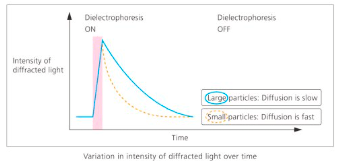
An alternating voltage is applied to electrodes arranged in a special way and placed in a medium with dispersed particles. As a result, an induced diffraction grating is created (a certain arrangement of particles in a liquid). After the voltage is stopped, the particles begin to diffuse, and the diffraction grating collapses. Sensors record the change in light intensity during the collapse of the grating, which allows you to obtain data on the size distribution of particles. The method allows you to obtain a good signal-to-noise ratio even in the nanoparticle range, which makes it possible to make stable measurements with good reproducibility.
Technical specifications

*Measurements are possible if the conductivity of the solution does not exceed 400 µS/cm. For example, saline or seawater cannot be measured without dilution.