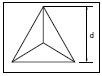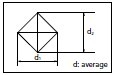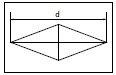



Microhardness testers of this series are designed for use in all branches of industry and are used to determine the surface hardness of materials and finished products. The unambiguous measurement of the depth of dynamic indentation allows, in turn, to measure very thin films and surface layers that cannot be measured by conventional methods. In addition, the same method provides the data necessary for calculating the modulus of elasticity of test specimens. The equipment fully meets the high requirements imposed on work in laboratories and in production.
DUH-211/DUH-211S series
Dynamic microhardness testers

Features
- Determination of hardness and material properties in accordance with accepted standards (ISO 14577-1 Annex A. “Metallic materials”). Instrumental indentation for the determination of hardness and material properties – Part 1: Test method. Annex A.
- High-precision estimation of elastic modulus. The assessment is carried out taking into account corrections for the rigidity characteristics of the instrument itself and the shape of the end of the tender..1
- Determination of material parameters based on “load / indentation surface” data.
- Low test force with a resolution of 0.196 μN. Controlling the force applied during the test process with a resolution of 0.196 μK allows measuring the strength properties of the material in microregions and on the outer surfaces of the samples.
- Wide load range from 0.1 to 1961 mN.
- High-precision indentation depth measurement. There is no need to measure the actual indentation. The indentation depth of the specimen can be measured with an accuracy of 0.0001 μm for depths up to 10 μm.
- Support for a wide range of test methods. Display of the relationship between test force and indentation depth. Ability to test the sample in loading and unloading mode. The DUH-211S model allows for cyclic and step-by-step loading and unloading tests.
- Supports Vickers and Knoop hardness tests. The diagonal length measurement function is included in the standard configuration. This function allows hardness measurements that correspond to plastic deformation only, Vickers hardness and Knoop hardness (Vickers indenter and Knoop indenter are available as options). The maximum magnification of the microscope is 500 × (1000 × is available as an option).
* 1 Limb shape correction is available only for the indenter with a triangular-pyramidal shape and an angle of 115° (this option is not available for other indenters).
Areas of application:
- Thin films (specially treated surfaces, e.g. nitride layer)
- Plastics
- Rubbers, rubbers and other elastomers
- Metal products
- Fibers (ultra-thin, such as optical fibers and carbon fibers)
- Brittle materials (glass, ceramics, etc.)
- Microscopic electronic components.
Measurement principles
Expression for dynamic stiffness
- Triangular pyramidal indenter with 115° angle (standard configuration)
DHT115= 3.8584 × F / h2 - Triangular pyramidal indenter with 100° angle (optional)
DHT100= 15.018 × F / h2 - Vickers indenter (optional)
DHV = 3.8584 × F / h2 - Knoop indenter (optional)
DHK = 1.5583 × F / h2
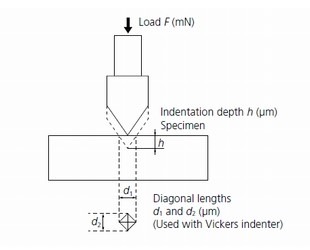
Expression for Martens hardness (ISO 14577-1, Annex A)
- Triangular pyramidal indenter with 115° angle (standard configuration)
HM115 = 1000 F / 26.43 × h2 [N/mm2] - Vickers indenter (optional)
HMV = 1000 F / 26.43 × h2 [N/mm2]
Hardness expressions based on diagonal length
- Triangular pyramidal indenter with 115° angle (optional)
HT115 = 160.07 × F / d2 - Triangular pyramidal indenter with 100° angle (optional)
HT100= 121.53 × F / d2 - Vickers indenter (optional)
HV = 189.10 × F / d2 - Knoop indenter (optional)
HK = 1451.1 × F / d2