



TOS-4200 allows for automatic measurements in multiple streams (from 1 to 6 streams). The creation of such an analyzer was made possible by using the low-temperature catalytic oxidation method developed by Shimadzu specialists at 680 °C, which avoids vitrification of inorganic salts and, thereby, significantly increases the service life of the catalyst and reaction tube.
TOC-4200
Multichannel flow total organic carbon analyzer

Technical specifications
- Standard working concentration range: from 5 mgC/l to 20,000 mgC/l. It is also possible to conduct highly sensitive measurements with a working concentration of up to 1 mgC/l.
- Measurement cycle: 4 minutes.
- Sample dilution function (supports a dilution range of up to 50x). The ability to dilute the sample is especially relevant when analyzing samples containing acids, alkalis or inorganic salts, and allows you to avoid damage to the instrument.
- The ability to build a multi-point calibration curve using one standard sample.
- The ability to determine total nitrogen.
- Functions for converting the TOC indicator into the so-called chemical oxygen demand (COD).
- The built-in memory allows you to store up to 20,000 measurements, 100 calibration curves. The presence of a built-in USB drive, which allows you to transfer measurement results to a personal computer.
- The ability to conduct measurements not only in online, but also in offline mode.
Main objects of analysis
- Water at treatment plants. A short measurement cycle (minimum 4 minutes) and thermocatalytic oxidation combined with the ability to switch between flows allows for detailed monitoring of the operation of treatment plants, quickly determining the presence of organic contaminants and, as a result, identifying possible anomalies.
- Natural water (rivers, lakes, etc.), purified and tap water. Monitoring changes in natural water quality under the influence of precipitation or other natural factors ensures control of indicators necessary for water purification processes.
- Process water of enterprises (condensate, flushing water, cooling water, etc.). Continuous monitoring of water used in the enterprise. Boiler water quality control allows you to detect possible anomalies associated with pipe damage.
Types of samplers
Various samplers allow you to work with both ultrapure and heavily contaminated water containing undissolved particles.
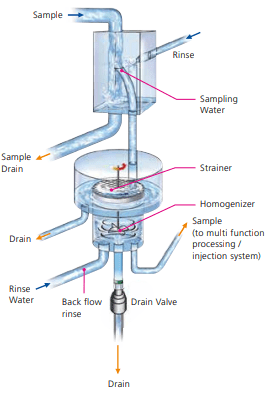
Multi-channel sampler for samples with suspended particles
- Used for samples with a fairly high content of suspended particles.
- The maximum number of sample streams (lines) is 6.
- The separation of the sample preparation and sampling blocks allows you to reduce the number of parts that require regular maintenance.
- Includes a homogenizer equipped with a filter.
- The filter is very easily contaminated, as it is in direct contact with the liquid during sampling. Using a rinsing solution after each sampling reduces the likelihood of algae, mucus, etc.
- Required sample flow rate: about 10 l/min.
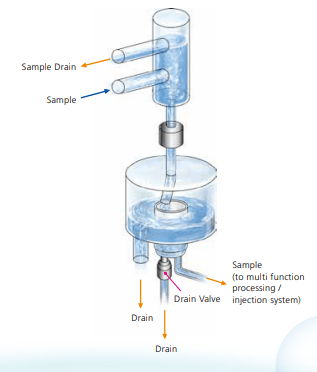
Multi-channel sampler with flow switching system
- Used for samples with low suspended particles.
- The maximum number of sample streams (lines) is 6.
- Primarily used for pure water analysis, the sampler is designed to minimize sample contact with air.
- Required sample flow rate: 1 to 3 l/min.
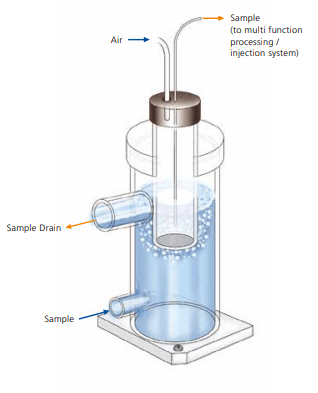
Sampler with backwash system
- Used for samples with low suspended particles.
- Equipped with an automatic backwash – air purge device.
- A bactericidal agent is installed in the air line, which prevents the mesh filter from clogging with microorganisms and the growth of algae and mucus.
- Required sample flow rate: from 1 to 3 l/min.
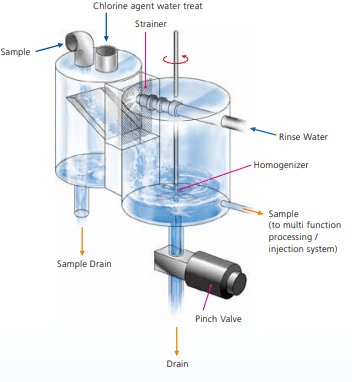
Single-channel sampler for samples with suspended particles
- Used in the case of samples with a fairly high content of suspended particles.
- The presence of an electric drive, no need for air supply.
- The impurities present are removed using a filter, then the homogenizer grinds and mixes the sample with suspended particles to ensure stability in measurements.
- The filter gets dirty very easily, because it is in direct contact with the liquid during sampling. Using a rinsing solution after each sampling reduces the likelihood of algae, mucus, etc.
- The installed bactericidal agent prevents clogging of the mesh filter with microorganisms and the growth of algae and mucus.
- Required sample flow rate: from 2 to 5 l/min.