



The ICPE-9800 series spectrometers are new generation systems that are characterized by excellent accuracy, necessary for simultaneous rapid determination of a large number of elements, regardless of their concentration level. A characteristic feature of the IZP-AES spectrometers of this series is user-friendly software that makes analysis simple. In addition, low running costs when operating the IZP spectrometers provide the highest level of productivity in the industry. The ICPE-9800 series is the best solution in atomic emission spectrometry for performing tasks of analysis of environmental objects, pharmaceutical industry, food and chemical industry, metallurgy and mechanical engineering, and other branches of science and production.
ICPE-9800
Inductively coupled plasma atomic emission spectrometers

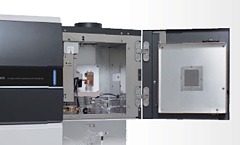
Maximum performance due to design features
- The dual plasma observation system is ideal for analyzing a wide range of samples;
- The advanced CCD detector with a matrix of 1 million pixels is able to register all wavelengths of all elements simultaneously;
- Three gas-saving functions reduce argon consumption by half.
Determined elements and measurement ranges
The ICPE-9800 series spectrometers allow for both qualitative and quantitative analysis of various objects and provide simultaneous determination of most elements of the periodic table, including non-metals such as I, P, S, Si.


IZP-AES models: ICPE-9810 (axial plasma inspection) and ICPE-9820 (dual plasma inspection: axial and radial)
For axial inspection, a photometric block (cooling jacket with flame arrester) is used, which is installed perpendicular to the burner. In such measurements, a small amount of purge gas is directed in the axial direction to remove the upper low-temperature part of the plasma and capture the hot part of the torch. This prevents contamination of the photometric block. The vertical (radial) arrangement of the burner minimizes the sticking of the sample to the burner walls, thereby reducing the memory effect. Simultaneous analysis is performed by switching between axial and radial plasma inspection.
Analysis of highly concentrated samples and organic solvents
When using radial inspection alone for analysis of highly concentrated samples or certain organic solvents (e.g. xylene), the cooling jacket can be removed. This procedure is simple.
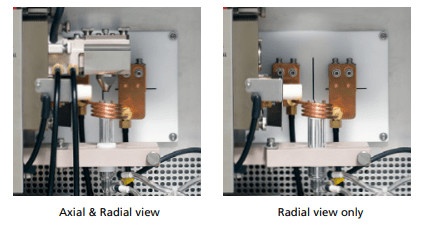
Simplifies the measurement of organic solvents
There is no need for oxygen when analyzing organic samples, such as drug solutions in dimethylformamide or petroleum products dissolved in xylene. Optimized plasma conditions and a vertical torch significantly reduce soot at the torch tip, thereby ensuring stable analysis. In addition, since an oxygen cylinder and additional gas lines are not required, there is no need for additional installation work, which in turn reduces additional costs.
Reduced operating costs
The ICPE-9800 series atomic emission spectrometers have three design features (mini-burner, eco-mode, and vacuuming) that significantly reduce argon consumption.

Eco mode (standby mode). In this mode, the power of the RF generator is reduced and the argon flow rate is halved (up to 5 l/min), thus reducing gas costs and electricity consumption.

Mini torch. Due to its smaller size, it allows you to reduce argon consumption by up to 50%, while maintaining high analysis sensitivity.

Vacuuming. The spectral unit is under vacuum, which means that there is no need to use additional high-purity purge gas. In the ICPE 9800 series spectrometers, argon with a purity of at least 99.95% is allowed.
Improved security
ICPE atomic emission spectrometers are equipped with a large number of safety sensors. In the event of any failure in the system, the plasma will not ignite, and the ICPEsolution software will display a message about the error that occurred and how to eliminate it. If a failure occurs outside the instrument (for example, in the power supply) during plasma operation, it will automatically turn off.
Technical specifications
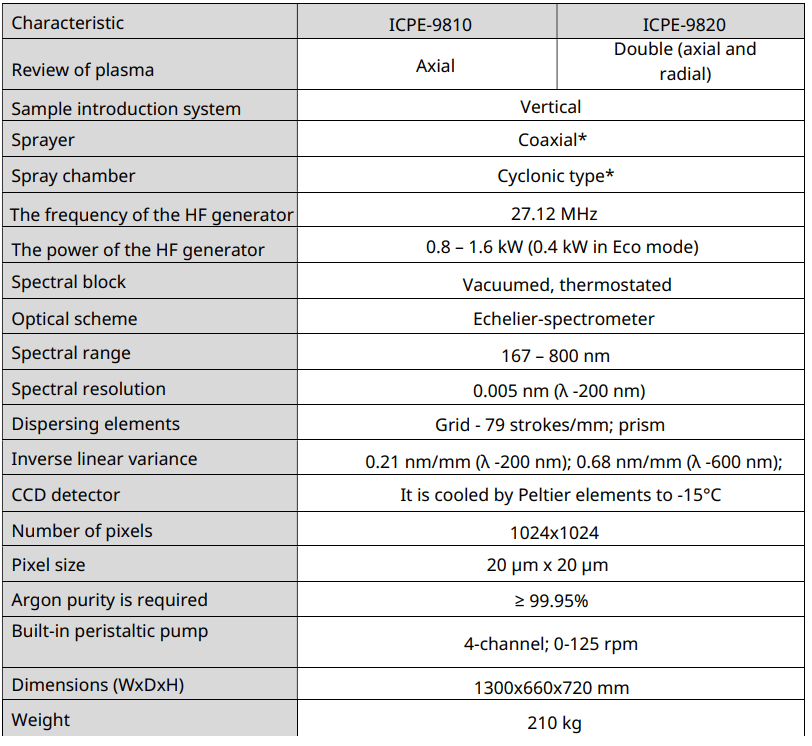
* Standard equipment
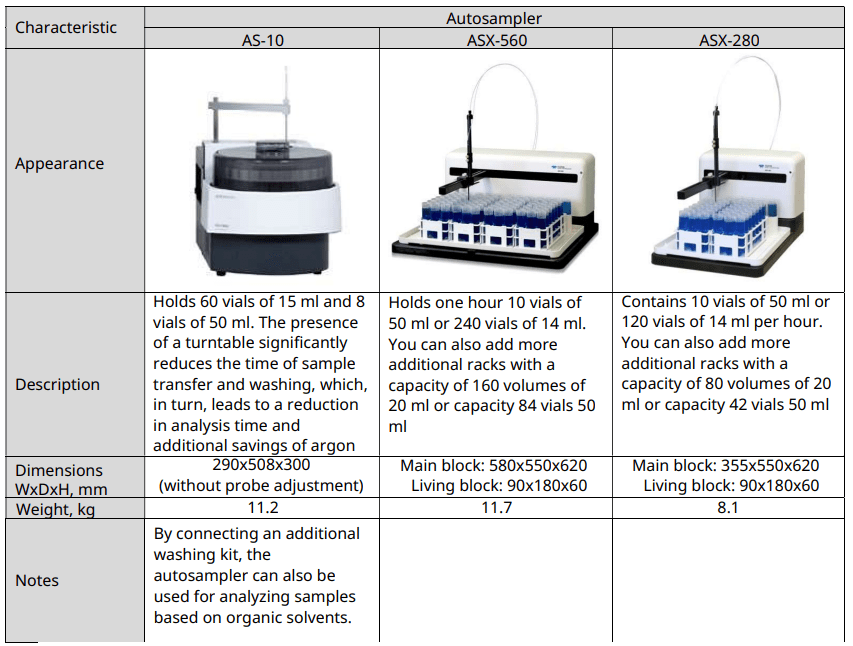
Autosamplers
Autosamplers are used for automatic and sequential sample feeding into the spectrometer input system. The operator only sets the sequence of samples (including calibration and washing) in the ICPEsolution software and starts the analysis. After the measurement of all samples, the system is automatically washed and the plasma is automatically turned off. When performing analysis on ICPE series spectrometers, it is recommended to use one of the following autosamplers:
Sample introduction systems
The sample introduction system in the ICPE-9800 series spectrometers is located vertically, which minimizes burner contamination during analysis and reduces the memory effect. The system consists of several parts: a burner, a connecting tube, a spray chamber, a sprayer and a water seal. Thanks to convenient connecting clamps, the system is assembled and disassembled in a matter of minutes, without requiring additional adjustment of the burner orientation. Depending on the nature of the sample solution, the introduction system is used in a certain configuration. The sample introduction system can be purchased as a kit or its components separately. The optimal configuration is selected for specific tasks.
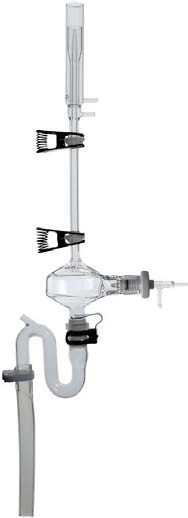
Standard sample introduction system. It includes a mini-burner. Due to its small size, the gas speed for plasma generation is only 8-10 l/min (within this range, the operator can set the required speed to optimize the analysis). All components are made of high-quality glass, and the burner itself is made of quartz. This system is ideal for solving most analytical tasks, and is also used when performing initial and periodic calibration of the instrument.
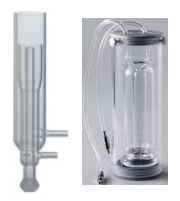
Sample introduction system for high salt solutions. When regularly operating a conventional system for introducing solutions with a salt content of more than 5% (mineral and sea waters, some biological samples, solutions obtained after fusion and/or sintering), there is a high probability of clogging of narrow holes in components (the internal nozzle of the sprayer or, for example, the burner), leaching of the glass surface and, subsequently, rapid wear of the product. To avoid this effect, it is recommended to use a system for high-salt solutions. It includes a reinforced burner of standard size, a special SeaSpray sprayer and a bubbler, the main task of which is to humidify the carrier gas before it enters the sprayer. With such a system, it is possible to reliably and repeatedly analyze solutions with a high salt content.
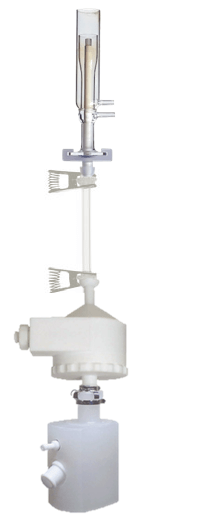
Sample introduction system for solutions containing HF. It is well known that when using hydrofluoric (hydrofluoric) acid during sample preparation (e.g., acid digestion of soils, glass, ceramics, etc.), glass and quartz vessels cannot be used. In such cases, we recommend replacing the standard sample introduction system with a system made of polymeric materials inert to hydrofluoric acid.
Sample introduction system for organic solutions. If the samples are organic in nature or easily soluble in organic solvents, using this injection system, you can avoid the time-consuming sample preparation stage and introduce the sample directly into the spectrometer. This also reduces the likelihood of sample contamination, partial loss of its components and avoids multiple dilutions. Such tasks are relevant, for example, in the petrochemical, pharmaceutical, food industries, etc. The properties of organic solvents can differ greatly from each other: viscosity, volatility, etc. In this regard, there are several options for configuration:
- Low-volatility solvents (DMF, xylene, etc.). A standard-sized burner and Scott spray chamber are used.
- Medium-volatility solvents (alcohols, toluene, acetonitrile, etc.). A special burner for organic solvents with a narrowed internal nozzle and Scott spray chamber are used.
- Highly volatile solvents (acetone, gasoline, naphtha, etc.). A special burner for organic solvents with a narrowed internal nozzle and Scott spray chamber are used, with additional cooling.
*Instead of the Scott spray chamber, an IsoMist programmable temperature spray chamber can be used with additional cooling.
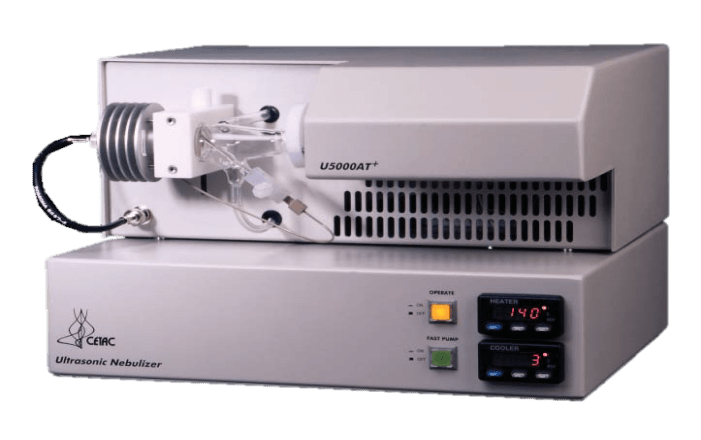 Ultrasonic atomizer. The standard configuration uses a coaxial atomizer, which atomizes the sample due to the difference in pressure created inside the atomizer by the carrier gas flow. The result is an aerosol consisting of large and small droplets. Only small droplets enter the burner, and then into the plasma. Therefore, the more small droplets the atomizer produces, the higher the sensitivity. In an ultrasonic atomizer, the sample solution enters a plate that vibrates at the ultrasonic frequency, due to which more small droplets are formed. The resulting aerosol then passes through a heating chamber, where the solvent is partially removed, and the sample particles enter the burner. This allows you to maintain plasma stability and avoid the time-consuming concentration procedure at the sample preparation stage, increasing sensitivity.
IsoMist programmable temperature spray chamber. The temperature of the cyclonic chamber is set by Peltier elements in the range from -10 °C to +60 °C. The temperature is controlled by software. By maintaining a constant temperature in the spray chamber, signal stability is improved.
Peristaltic pump
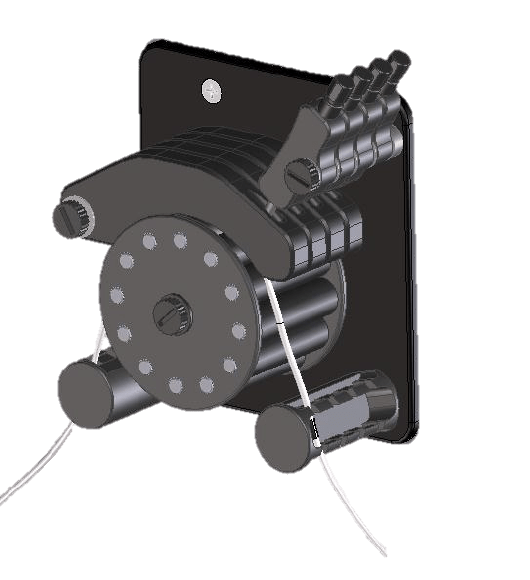 Since the sample introduction systems of the ICPE-9800 series spectrometers use a high-efficiency sprayer for free introduction of the sample solution, in most cases there is no need for peristaltic pumps.
However, you cannot do without it if:
- the sample solution has a high viscosity
- a hydride generation attachment is used
- a kit for automatic addition of the internal standard is used
- a supersensitive nebulizer is used
The 4-channel peristaltic pump is mounted on the device body. It is controlled using the ICPEsolution software. The operator can set the pump speed in the range of 0-125 rpm.
Kit for automatic addition of internal standard
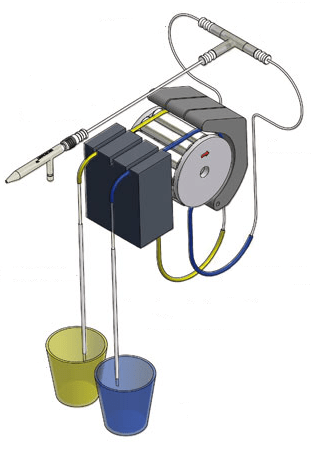
When performing some measurements, it may be necessary to use an internal standard. An internal standard is a solution of a selected/recommended chemical element with a certain concentration, which is added in the same amount to all measured solutions (sample, blank, standard). The internal standard solution can be both aqueous and organic, depending on the task. To avoid errors in the preparation of such solutions and save time, we recommend using this kit.
The internal standard solution is supplied through one channel, and all other solutions through another. Using a “tee”, the solutions are combined into one stream and enter the sprayer. The ratio of the supplied solutions is regulated using hoses selected in advance by thickness.
This kit can also be used to introduce solutions of other origin, for example, ionization buffer. The kit can also be connected to an autosampler.
HVG-1 hydride generation and mercury detection kits
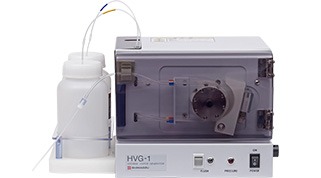 The prefix is used for highly sensitive determination of As, Se, Sn, Sb, Bi, Ge and Te in various objects with the preliminary formation of a volatile hydride of the element being determined. Also, using this prefix, it is possible to determine the content of Hg, previously reduced to the atomic state. The determined element, when interacting with a reducing agent (NaBH4, SnCl2) in an acidic environment, is separated from the solution matrix and already in a volatile form enters the atomizer, which allows avoiding matrix effects and increasing the sensitivity of the measurement.
ICPEsolution software
The ICPEsolution software contains a large number of useful options, thanks to which even an inexperienced user will be able to successfully conduct any analysis. At the client’s request, the software can be installed in both English and Russian. Depending on the task, the analysis can be carried out:
- Quantitative (with the construction of calibration curves using standard samples or the method of standard additions)
- Qualitative. Includes the determination of all possible elements in one measurement, display of the profiles of the obtained spectral lines and, thanks to the built-in database, display of the approximate content of the determined elements
Two unique options
Method creation assistant. You only need to conduct a qualitative analysis of the sample, then the Assistant analyzes the information received and offers you:
- Optimal wavelength*
- Correction, if there is inter-element influence
- Concentrations of calibration solutions
*The program determines the optimal wavelength automatically for a specific sample depending on the peak/background ratio.
Results Check Assistant. After conducting a quantitative analysis, the Assistant will check the measurement results and report any errors, for example:
- The analysis results are incorrect due to the presence of inter-element influence
- No background correction
- The content of the determined element does not fall into the calibration graph, etc.
The Assistant will also provide recommendations for eliminating these errors. The ICPEsolution software allows not only to optimize measurement parameters, but also to select different measurement conditions for different elements determined during one measurement, in particular, to determine most of the elements under standard conditions, to set a reduced power of the RF generator for determining alkaline elements and to set a more sensitive measurement mode for elements with low content.
When analyzing certain objects, various types of correction may be necessary. The ICPEsolution software includes:
- Inter-element correction
- Drift correction
- Internal standard
- Background correction
The ICPE-9800 series spectrometer software has an extensive database. It contains the most frequently used wavelengths of all elements, but, if necessary, the user can always add additional wavelengths to the database. Additionally, you can purchase a version of the ICPEsolution software that meets the requirements of electronic signatures and records prescribed in Part 11 of Chapter 21 of the Code of Federal Regulations (FDA CFR).